What Are You Talking About?
Every game developer has a dream game to make. Whether that would be a dungeon crawler like Diablo, a platformer like Mario, or even an MMORPG like the very famous and definitely successful Albion Online. But, as you venture into the land of solo–or small team–indie development, you discover that making any of these games is either way too hard, or just unprofitable. At a certain point, an indie has to think small. They have to create a constrained game that can be managed and finished in a reasonable amount of time. No RPGs, no open worlds, and certainly no MMORPGs.
Speaking for myself, I’ve been playing RPGs and their derivatives all my life. Oblivion, Baldur’s Gate, Diablo, Deus Ex, Dark Souls, and the like. If I diverge from this path, I don’t go far away. God Of War, Max Payne, and Metal Gear Solid. Making an RPG or a story-driven hack and slash will be a very hard task for an indie development studio (whether that would be solo or a team). The time, effort, and money needed to complete such a task in a reasonable time might as well be impossible. For that reason, indie devs often pick “easier” genres for their games. These genres often don’t need a large open world, nor a long and fancy list of items to find in dungeons, so that you can sell to dumb players for real money later. Instead, they cater to the most fundamental gameplay mechanics. It is in this small scale that indie devs thrive. The small and the niche. The sweet and the tiny. Look at games like Balatro, Stardew Valley, or The Binding of Isaac. The scope of these games is small and manageable. They aren’t overrun by useless mechanics that do not contribute to the core of the game.
However, making a small game as an indie is not as easy as you might think. That is especially true for those who have been playing RPGs and similar big games all their lives. In order to know how to scope and handle a small game, one must first plunge oneself into the depths of similar games. Games that were also limited by some capacity, reflecting such a limitation onto their designs, art, or overall scope of their project. And, for me, the best place to look for such examples is the games of yesteryear…
The Small And The Original
Due to the memory limitations of the past, the rather small teams, and the barely available toolset, game developers had only a narrow set of games they could make. The levels were much shorter, the character sprites were much simpler, and techniques like procedural generation were much more prevalent, since it’s much cheaper to generate a level on the fly rather than to keep it alive in memory. Because of these limitations, the only way games can stand out is by how fun they were. Game design was the master, and it’s where developers poured their time into to make a better game that could be played. Just having a ship move around was not enough. Making a level with beautiful graphics, while impressive, was not really possible or practical. And so, game design was the only thing that could bring folks to the arcades or buy games for their very expensive home consoles.
Arcade games were much more difficult, but super addictive. That way, people weren’t able to beat it in one setting, yet they kept coming back for how addictive the games were. For home consoles, that, too, was the norm. Yet, with home consoles, you did not need any quarters to play. You could just press a button, and the game would be reset. That design really should have been retired, considering it was made for arcades. Nonetheless, the most important aspect of these games was the design. Nobody really focused on the graphics, the story, or the music. It was just how fun the game was. Of course, nowadays, things haven’t changed much. We still pick up games by how fun they are to each of us individually. But we sometimes get enamoured by the graphics or the music, thinking that these are the essence of the game, only to be shocked to realize that the game is actually not that fun. It just had really talented artists and musicians. For the older games, however, they did not have that element.
When you play an older game from a game designer’s perspective, you’ll realize that the game is, in essence, just bones. It has the most fundamental game design elements that a lot of games in the future will inherit from. Whether that would be the dungeons in The Legend of Zelda, or the character controls in Super Mario, they are all in their most basic form, showcasing themselves to you without any extra fluff. The design elements are rudimentary, yes, and even unpolished (to us at least), but they are in their infancy state. You can almost see every reason for its inclusion. Every game mechanic can be taken and inspected very thoroughly. And that’s something we cannot easily do with modern games. Most games (especially AAA games) are built upon decades of game design knowledge and practices. While it’s not impossible to learn about game design from modern games, it is easy to get distracted or even misunderstand why a certain mechanic is the way that it is.
Often in modern games, their mechanics are taken from much older games, either from the designer’s childhood memories or from extensive research of the same genre. These mechanics are taken, improved, modernized, and then put into the game. For the player, this is very smart and innovative. Yet, for the designer who is trying to learn the art of game design, it is almost like trying to figure out a magic trick, the truth of which has been buried under layers and layers of deception.
Game developers who love Dark Souls might think that the fun comes from the difficulty. But not every difficult game is fun. Perhaps it’s the lore, the environment, the voice acting, the intricate 3D models, or the haunting music. But, in reality, it’s none of those things. Those elements exist, yes, and they enhance Dark Souls to another level that makes it so legendary. But when you look at the bones–the skeleton–of Dark Souls, you’ll find that it’s none of those things that make it such an addictive and fun experience. And that’s the deception I’m talking about.
For example, let’s take a look at the pioneer of twin-stick shooters: Robotron: 2084.
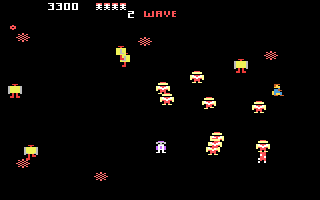
Simple sprites, a black background, and very simple 8-bit sounds. Back in 1982, this game was a huge hit, starting a long lineage of twin-stick shooters. Its contemporary successors, such as Smash TV and Total Carnage, took direct inspiration from it, and themselves were huge hits. However, nowadays, when you look at it, you see an old game with ugly sprites, a simple background, and terrible 8-bit sounds.
Now let’s take a look at a more modern example of the same genre: Nex Machina.
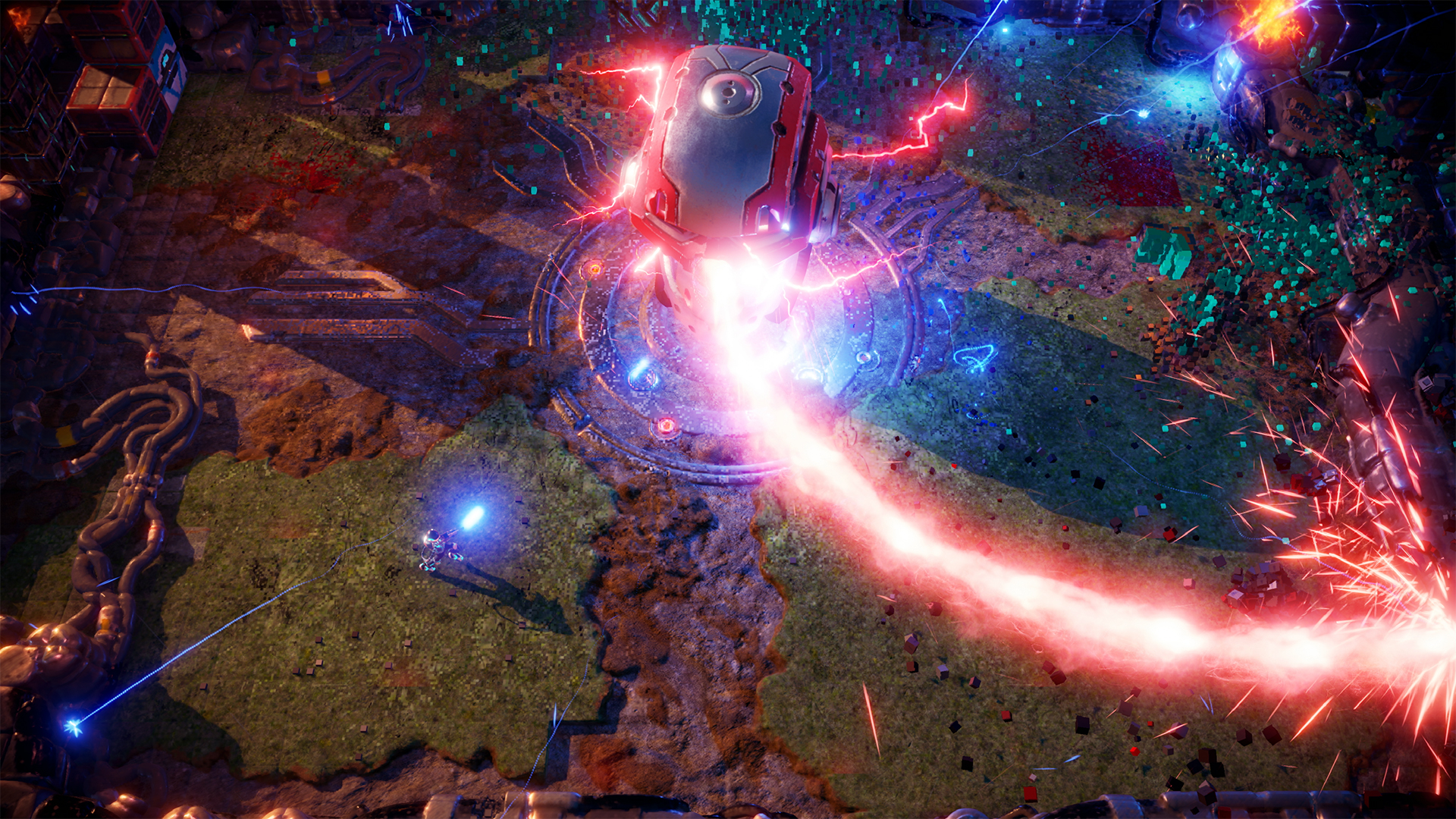
Can you spot the difference? If you said the graphics were different, then you’d be right. If you said it was the cool effects, then you’d be right. And if you said the music, then you’d be absolutely right. But if you said the gameplay… well, that’s where you’re wrong.
The Skin And The Bones
Nowadays, we are used to a lot of quality-of-life features that did not exist back in the day. And I’m not just talking about pretty graphics or cool music. I’m talking about the practicalities that were unheard of back in the 80s and the 90s. Easier digital distribution, allowing you to buy literally any game you want. A thousand different controllers that work with every game with almost no friction. Multiplayer games that do not need any tinkering or any late-night devil-summoning in order to get it working. Polished UI controls, instant loading screens, crisp 120 FPS, and I could go on and on. Now, unlike a lot of people on the internet for some reason, I’m not saying that we should reject modernity and embrace the past. That claim is dumber than any that I’ve heard. However, from a game designer’s perspective, these modern quality of life improvements, while important to know and realize their existence, take away from the core element and reason of what makes a game fun. Or, at the very least, it might misdirect you into thinking that the cool particle effects or the crisp sounds are what make this game fun.
If you’re a fan of the twin-stick shooter genre, and you decide to play Robotron: 2084, you’ll see a bunch of elements of many modern twin-stick shooters that exist in Robotron. If you can get past the simple graphics (which is not that difficult, honestly), you’ll see that, at its core, Robotron is a super fun game. I could see why this game was popular back in the day, and why so many games wanted to emulate the feeling it gave. That feeling of adrenaline rushing through your veins as you try to evade enemies, while killing as much as you can. Going from screen to screen, from wave to wave, feels like a reward well earned. I do admit it has some rough edges, but from a design standpoint, this game is amazing.
Playing such games allows you to see the bones. It will allow you, as a designer, to separate the gameplay from the visuals. The mechanics from the sounds. RPG games aren’t fun because they are pretty. They are fun because the designers try to elicit a feeling of immersion through the different interactions, quest designs, and skills/perks. They try to make the mechanics fun, rather than trying to make the game just look pretty. When you go back and play older RPGs such as Diablo, Fallout, Baldur’s Gate, Final Fantasy, or Earthbound, you’ll see those elements at their purest form. You can extract the knowledge from the deepest part of the well, without having to traverse a plethora of cool (and sexy?) 3D models of cows.
Once again, I’m not taking away from the art or the music. These are an essential part of the machine that every developer is trying to create. Without those parts, the machine will function, but boy, will it be dull. Without the art and the music, the game will feel hollow and uninteresting, even if it has a very deep and complex machine living underneath it. However, if you’re a designer, wishing to make immersive and fun experiences like the ones you have played for years, you must understand where it all originated. You have to understand the core elements of what makes a genre fun. You might think you know, but, believe me, you don’t.
For example, if you wish to make a really cool stealth game, you’ll have to play a bunch of stealth games. Perhaps you’ve played the very well-known games in the genre, such as Metal Gear Solid, Splinter Cell, and Assassin’s Creed. But these games are built upon decades of game design mechanics and knowledge. They have a lot of elements outside of design that help it stand out. I say you must play these games, of course, but you have to start with the origins. Go play the original Metal Gear (on the Famicom, since the NES version is not the best), and see the origins of that amazing series. Hell, go play the original Castle Wolfenstein. It’s very rough, yes, but you’ll learn a lot from it.
You’ll see the purest form of stealth games. It’s hard to think that Castle Wolfenstein is fun because of the graphics. It’s the mechanics and the interaction of these mechanics with different gameplay systems. And then it’s tying all of that together into a bundle, worthy enough to be called a fun game.
And look, I’m not saying that you should play these games for hours or even days. Even though I love these games from the deepest depths of my heart, I can admit that they are rough and very outdated. Some are better than others, but most of them are a remnant of a much simpler time. I advise you to play them in an emulator and abuse the fuck out of the save and load feature. And don’t give me that, “but it’s not an authentic experience”. Seriously, go find someone who loves you, dude.
Your most important goal when playing these games is not to get an “authentic experience”. Instead, you will be trying to learn and study. You might enjoy the game so much that you’ll perhaps attempt to finish the game without the save and load features. But, for the time being, you are only trying to study the craft which lives in the game. You are not trying to perfect the game. Leave that for other people.
In general, your most important goal is to make a fun game. Without a fun core gameplay loop, you don’t have a game. You just have a really cool-looking toy. And in order to learn how to make a fun core gameplay loop at a small scale, you have to play the games that did it before you.
Game Over
Games are not easy to make. And I’m not talking about the difficulty of the tech or the art. I’m talking about the difficulty of making a fun game. That is an aspect that, unfortunately, often gets overlooked, even though it’s the most fundamental element of a game. And that comes down to how hard it is to measure “fun”.
“Fun” is not an algorithm you can code in an afternoon, nor is it a 3D model you’ll need to texture. It is, worst of all, an intuitive understanding we humans have. “Fun” is an intrinsic function within every game that might or might not be understood by the players. Your job, as a designer, is to understand that function, decode it, and use it to the best of your ability.
It saddens me when I see game developers saying that they don’t play any games. Have you ever heard of a musician who doesn’t listen to music? A filmmaker who doesn’t watch movies? A fucking carpenter who never buys wooden items? See how propastoures that sounds when put into other contexts? How can you make a game in a genre that you never played?
I believe that game developers who say such a thing just want to make art or code a cool algorithm within the context of a game, but not make a game itself. And that is fine, to be honest. But that’s not how games are made. Not any successful games, at least. Go read or listen to any interview of any game developer, old or new, and you’ll get the same answer. Any developer who starts a new game will not focus on the art, programming, music, or particle effects. They’ll focus on the most core element of any game: the design. Without a fun mechanic, a game is nothing but a pile of pretty sprites and neatly designed code. And to the gamers, that is nothing.
If a game is not fun with simple cubes and ugly sprites, then, believe me, it won’t be fun with pretty graphics and a killer soundtrack. At that point, it is a structure built on top of a very weak base. At any moment, it can–and will–fall, destroying all the hard work you put into it.
When you start a new game project, think carefully about which genre you like, and why you specifically like it. Play a bunch of games–old and new–in that genre, and decode every single element like an investigator, trying to find clues in a crime scene. Watch talks about the genre, read articles, and watch interviews from other game developers who made games in that genre. Treat game design like you treat the code, the art, the story, or the music in your games. Treat it like it’s supposed to be. Treat the design like art, man.
Thanks for reading, and have a good day/night.